Showing posts with label soccer. Show all posts

Tuesday, July 19, 2011

Team of Destiny, Meet Team of Destiny

Okay, so I really don't feel much like writing a post about the U.S. vs. Japan match. Or anything else, for that matter.

As an objective observer/soccer fan you have to be more than a little happy for a plucky Japanese team that had more of a never-say-die attitude than the Americans, who had made that their trademark in this World Cup. And that whole tsunami thing undoubtedly makes this a "feel good" story not only in Japan but worldwide.

Except here. Japan didn't win this one; we gave it away.  I wanted to pummel Ian Darke when he kept wondering if the U.S. would rue its repeated missed opportunities in the first 30 minutes of the match, but that was mostly because I suspected he was right (and for God's sake will someone please buy Julie Foudy a calculator?).

Still, those misses shouldn't have mattered. You have to be able to defend a one goal lead in the last ten minutes of any match. And particularly a World Cup Final against a team that had, for 80 minutes, displayed a remarkable lack of finishing ability and had failed to pose a single legitimate offensive threat.

It was the first of the two Japanese goals that was particularly heinous. Horrible, desperate defending when it wasn't necessary or called for. Usually you speak of offensive players who "choke" but it certainly appeared that it was the U.S. defenders who did exactly that, gifting Miyama an opportunity she didn't deserve but, to her credit, she put away.

Not the celebration U.S. fans were hoping to see,
particularly in the 116th minute with the lead.

When Sawa scored the second, with only four minutes to play in extra time, it seemed to seal the deal. It wasn't the U.S. that would be the improbable winner in this match. The shootout was awful to watch and, surely, worse to actually participate in.

So we're left with a lot of good memories and renewed attention, at least temporarily, to soccer in general and women's soccer in particular in this country. But oh, what could have been, if only we had decided to clear the ball upfield instead of treating it like a pinball in our own six-yard box.

And, if nothing else, this match proved exactly what makes soccer unique among all sports: one team can dominate another and still lose. That is indeed what makes soccer so maddening, and so irresistible at the same time.

The next Women's World Cup is in Canada. Anyone else in?

Sunday, April 17, 2011

Support Your Local Soccer Team

Because the vast majority of U.S. soccer fans of my generation didn't grow up playing soccer, they chose the sport rather than the sport choosing them.

This is not always a good thing.

Much as the former two-pack-a-dayer becomes the most strident anti-smoking advocate, so too many converted American soccer fans become soccer snobs, insisting on only following the best of European or South American soccer and deriding the level of play in MLS, let alone that of the lower division leagues in the U.S., the United Soccer Leagues (USL) and Professional Development League (PDL).

No, the MLS is not the Premier League. But neither is the Scottish Premier League, or the Ukrainian Premier League, or even Ligue 1 (France's highest professional league).

At the end of every Mountain Stage, Larry Groce tells the audience to go out and listen to some live local music. He's not saying it will be as good as what you just heard on the show, but that's not important. What is important is the idea of local music, of supporting its existence and the people who are probably not even eking out a living performing it, but are doing it just the same and could use a little support while pursuing their dream.

The same goes for local soccer. Whether it's the Columbus Crew or the Portland Timbers or even D.C. United, MLS has to play an important part in the development and vitality of the game in America. U.S. soccer fans need to support MLS, through attendance or even just watching games on t.v., to increase the presence of the game in our national psyche, and especially its attractiveness as a marketing tool to potential advertisers.

Even more desperate for a little support are local soccer clubs. While the level of play isn't always great, the atmosphere and support of your team (even if it's your club only for that evening) is. Perhaps the two most enjoyable times I have ever spent at soccer matches were in York, England watching a pre-season match of what was then Third Division York City F.C. against Middlesborough and an overweight and fast deteriorating Paul Gascoigne, and in Charleston South Carolina watching the USL's Battery play at its wonderful Blackbaud Stadium.


Here in West-by-God Virginia's Charleston we have a PDL team, the Chaos. The PDL is, as its name indicates, a developmental league. Most of the players are local college players, looking for extra playing time in the summer and perhaps that "break" to move to the next level. The play is at the level of a good Division II college program.

No, you're not going to see Lionel Messi on the Schoenbaum Stadium pitch -- probably not the next Lionel Messi either. But there are few ways to spend more a pleasant evening than sitting in the stands, watching some local boys try to make good while the sun slides down the horizon behind the Appalachian Mountains leaving the sky streaked purple and pink.

So next time you find yourself at home on a Saturday or Sunday with nothing particular to do, go find a local game, drop a few bucks, and, as Larry Groce might say, watch some live local soccer wherever you may be.

Tuesday, October 5, 2010

My favorites of womens soccer

Hello! Today I figured that I would let everyone know who I support in the world of womens soccer! What teams and players are my favorite and all that, so let us begin!
Favorite teams:
For International teams, my favorite team is the USWNT!
Along with the USA, I also support the national teams for, Australia, Germany, and Canada
Ill be rootin for these teams during the Womens world cup in Germany 2011!

As for my favorite club or domestic team, I love and support the Washington Freedom!


 The Freedom is an awesome team, and its a shame that we lost in the playoffs this year! Well get em next year!!
Now to move on to my....
Favorite Players!
Well I have quite a few, so I'll only mention some here, lets start off with my top favorite:
USWNT and Washington Freedom Defender #4 Cat Whitehill!!!
Cat is an awesome player! Shes a great defender and has a great long range kick! Her kicks are always accurate and are usually put right in front of goal so one of her teammates can head the ball home! Go Cat!

My #2 Favorite will have to be


USWNT and Washington Freedom Forward #20 Abby Wambach!!
Abby, in my opinion is the best forward in the world, yes. I picked her over Marta! I truly believe that Abby is a better player than Marta, sure she dosent have all that "Brazilian Flare" but she scores loooots of goals and is a great team player! She isn't a ball hog, and passes often, which is why she has lots of assists! And some of her goals are just insane, not to mention her headers and diving headers which are always great! Her height sure helps her in that department! I think that Abby will lead team USA to a win in the 2011 World cup!! Go Abby!

And my #3 Favorite player, and last one for this post is....
Canada WNT and FC Gold Pride Forward #12 Christine Sinclair!!
Christine is another great forward that I like! Shes like Wambach as she scores awesome goals, but she also passes and has lots of assists! She is often overshadowed by the great Marta on FC Gold Pride yet she still did amazing and led WPS in assists with 9 on the year, so hopefully the upcoming world cup will be her time to shine on a world stage! Go Christine!
Some of my other favorites are, 

Tiffany Weimer ^


Rebecca Moros ^

Megan Rapinoe ^


Amy LePeilbet ^


So there you have it! my faves of the womens soccer world! Of course there are other teams I like and many other players I like a lot, but I didnt wanna make this post a mile long giving everyone there own section! So this is all for now! Thank you very much for reading! And be sure to catch the USWNT take on China PR tomorrow on ESPN 2! Who is your favorite player and whats your favorite womens soccer team? Let me know in the comments if you like!!

Saturday, September 18, 2010

A Delicate Balance

I didn't play team sports in high school. I went to a big public school and, frankly, was to small to be able to play football or baseball (and too old to play soccer, at least in Michigan).

Swimming and golf, though were two sports that weren't particularly discriminatory with regard to size (although admittedly you won't find many 5' 9 1/2" Olympic swimmers). I didn't learn much from my high school golf coach that I've been able to translate to my soccer team (unless it's simply to not be a confrontational, crotchety old SOB like he was), but swimming is a different story.

There were some conventional wisdoms in swimming 30 years ago that, while regarded as gospel at the time, haven't proven to be much more than voodoo or old wives' tales. We used to stretch a lot before meets (as opposed to currently, where static stretching is viewed as inhibiting muscle performance when done immediately prior to an event). We used to "carbo load" the night before big meets (not immediately before, like Michael Scott) which is of questionable value these days. And before and during meets we would eat plain sugar or jello mix because we thought the glucose would give us additional energy.

The one training tool that we practiced in swimming that I believe still has a great deal of validity, and is equally applicable to soccer, is "peaking." The idea was that there were only so many times during the swim season when an athlete could be at his or her best. So, while no one tanked any meets, it was understood that you wouldn't prepare for all meets in the same way (training hard, then tapering your training a few days before). Only the really important meets merited that type of training. Your performance in the run-of-the-mill meet or race may not have been optimal as a result, but that was okay because you had the big picture -- the county or state meet -- in mind.

As an athlete, peaking and tapering made a lot of sense -- maybe just because it meant I didn't have to work as hard at practice during the days leading up to a big meet.  As a coach, however, I find I have to constantly remind myself that I can't expect great things out of my team every game.

The high school soccer season lasts for 20 regular season matches in West Virginia. Add to that the possibility of up to five post-season games (if you make it all the way to the State Finals), and you have a situation where, realistically, your players cannot be as physically and emotionally sharp as you'd like them to be for every single contest.

It's a difficult concession for me to make, that we can't or even shouldn't be expected to play our best every single match. I'm competitive by nature and at any game want our team and its players to perform as well as possible. I find I'm more disappointed with a "bad win" than a "good loss" almost all the time.

But, as the cliche goes, a bad win really is better than a good loss.  After all, the ultimate goal for a game is to win, and for the season is to win a championship, not to look good losing or to win a relatively unimportant game 5-0 instead of 3-0.

Although I'm in my ninth season as a high school coach, I'm still learning better ways of doing things. There's a lot of introspection in coaching, as in legal work -- especially litigation. I find myself often examining the way I approach issues for an audience, whether it's my players, the press, a judge, or a jury. This year, I'm consciously making an effort to be satisfied with an occasional adequate performance, with the understanding that it would be too demanding to expect the team to play at a peak for 25 straight games.

There's still room for improvement in our team, just as there is in me as a coach. As a wise man once said, "when you stop getting better, you stop being good."

Sunday, September 12, 2010

Hope Solo's Twitter , She be hating!


Well these were all said after the Beat's 1-0 loss to Washington,
"Its official, the refs are straight bad. Its clear the league wanted dc in
playoffs. I have truly never seen anything like this. Its sad
"
"A goal taken away with no explanation, one offsides call against dc, many against atlanta. An amazing all ball tackle for a red"
"
We play with 10, DC with 12. Players punched in the face. Free corners. I am done playing in a league where the game is no longer In control of the players."
"
The head ref calls it a goal!!!! It even goes up on the scoreboard!!! Than no explanation! Its a joke!!!! An absolute joke!"

That was said the night of the game, these comments were then said the next day around noon:
"
Nice spin on the game report brunson. The little old 7th place team from
atlanta ran the show last night. was your head dizzy watching"
"
Us ping the ball around the field?I'm proud of us ATL,we are beginning to
show this league how the game should be played-beautifully."
"
Multiple choice question...why did the refs call back our goal? Is it... A. Free kick taken before the whistle
B. Indirect not direct"
"
C. Offsides D. Foul on unknown player
Those are all the reasons we heard, so I think E is the only one that really makes sense..."
"
E. We just want washington to win regardless"

And thats all. Wow Solo, really? shes just LOOKING for trouble, I am a fan of her and I think shes an excellent GK but whats all this crap about? I mean the ATL Beat had nothing to play for, they didnt even play THAT good! So Stop tootin your own horn Hope, and look, Officals in Mens soccer, Internationals, anytything! They all mess up! Not just WPS so wake up Hope. Wake up.

Also Cat Whitehill went on to say this on her twitter:
"
@hopesolo your bitterness isn't good for the game or your team"
Well put Cat! Excellent! So I mean hopefully Solo will see this and notice that her own damn USWNT teammate even told her to stop, so please, stop hurting the league and stop complaining!

Wednesday, September 8, 2010

WPS: Abby Wambach Autographs!

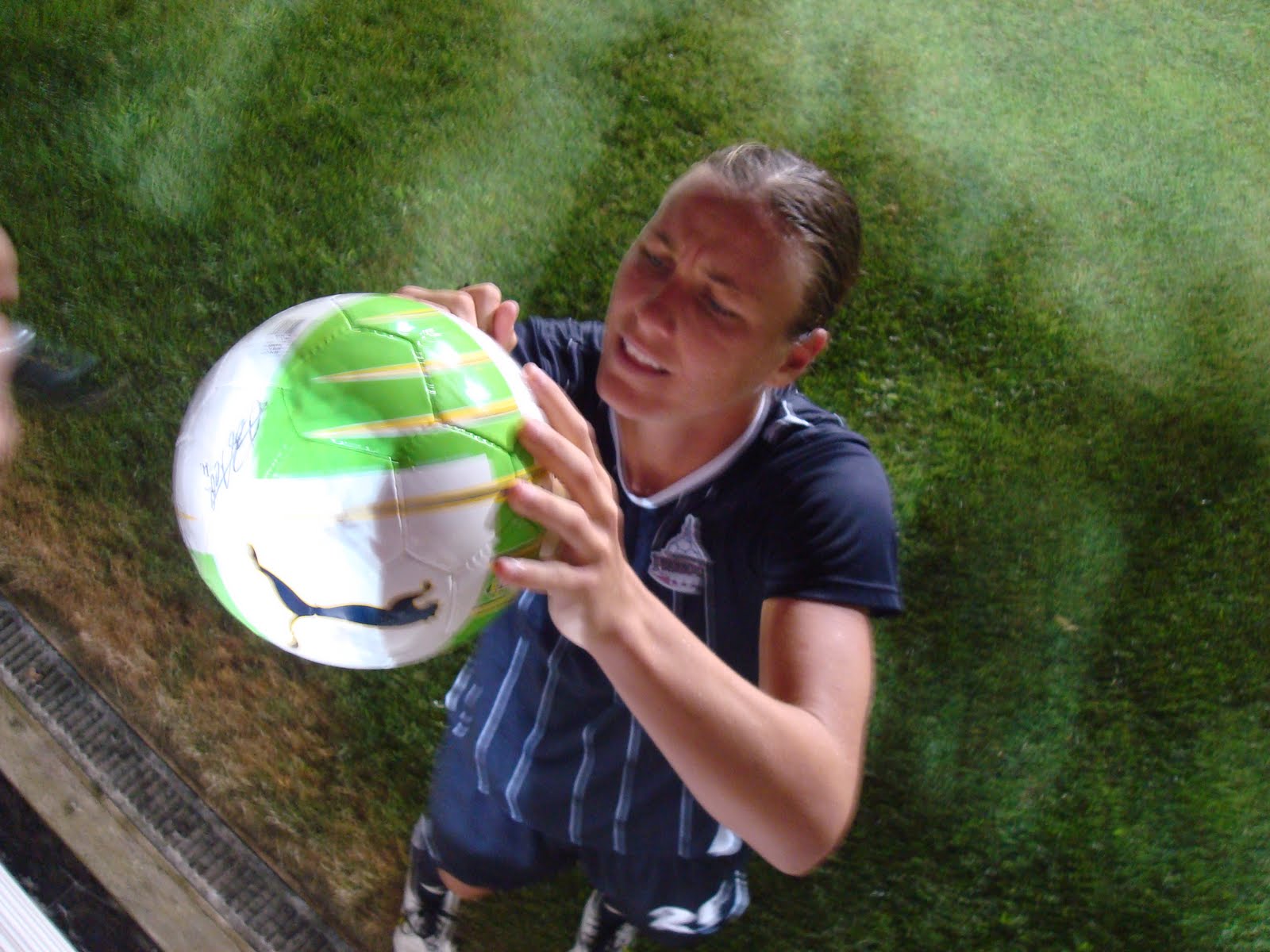
Hello everyone! Today i have a WPS themed post for y'all! (By the way, check out that awesome new picture at the top of the blog!) Today I have two of my favorite items in my collection, My Abby Wambach autographs!

 She was cool enough to sign my card And also this WPS PUMA Ball!


I went to the Sky BLue FC VS. Washington Freedom game on August 11th this year in New Jersey and I had a great time! I got a lot more autographs on that ball, but Ill save them for another post as this one is all about Abby!

And before the game I managed to get a great video of her warming up and doing lots of awesome tricks with the ball! Check it out!!


Abby is one of my favorite players! She is really something else, and In my opinion, The Best womens soccer player in the world! Yes, even better than Marta! Shes a great leader and I hope that she can lead the USWNT to victory at the 2011 Women's World Cup in Germany! Thank you for reading! And check back for more WPS Soccer, and Vietnam War stuff! Thank you!
-Anthony

Thursday, August 26, 2010

High Expectations

I've been struggling for the past nine months with how to deal with the expectations for our team for this season.

I prefer being the underdog. But it would be close to impossible to cast our team in that light this season and maintain any degree of credibility. It's always easier to lead when you can create an "us against them" mentality with your team. But this season, realistically, it's "them against us."

Our team has won two straight class AA-A state championships. We have nine starters returning, seven of whom are seniors, and seven of whom made one all-state team or the other. We've begun to receive notice outside of the state -- we will play the team that won the Ohio state "small school" championship game (they were later stripped of the title, under questionable circumstances in my opinion) in a game on Labor Day and our upcoming game against University High (last year's West Virginia AAA state champion) has already begun generating some buzz.

I think many coaches tend to ignore the psychological preparation for themselves and their team for a season. To me, that is the most important aspect of pre-season work for an accomplished and skilled team like ours. If you have a bunch of new or young players, then you need to get a ball on their feet as often as possible. But for our team, figuring out how to deal with the expectations and pressures of seeking a three-peat(c) was paramount.

Don't get me wrong, I'm happy to be in the position of having to deal with this kind of "problem." But it's easy for people to overlook the time spent off the field that goes into deciding how you will work your way through it, and that how you will handle and train a skilled team is just as taxing, just different, than doing the same for a younger or less talented team.

In the end, my choice was to simply admit that our prospects for the season should be promising and let the team know that it was up to them to decide whether we would achieve them or not. Fortunately, our players are very competitive and have even higher goals than most people would think. Planning how you will communicate with your team can be more important than planning what you will (and won't) tell people outside the team about what you're doing and why.

Although it's still early, so far we've embraced the expectations that we and others have placed on us. We spent a great weekend in Morgantown scrimmaging against some of the best teams in the state, I witnessed the best, most intense scrimmage I've ever seen when we battled University High on a lovely August evening, and we have already avenged our only loss from last season.

The view from University High's field the evening of our scrimmage.

There will no doubt be some bumps along the way (in fact, there were some in a scrimmage the morning after the University scrimmage), but the moments we've already experienced this season lead me to believe that sometimes expecting the most from your team, and telling them that, is the best option. Maybe even when it's not the only one.

Monday, July 12, 2010

"Now Let's Go Out There and Play Like We Want to Finish Third!"

It's so predictable it's a cliche: the third place games in World Cup tournaments are exciting, open matches; the title games are conservative, chippy, and at times downright dirty.

The supposed justification for the interesting "consolation" matches is that there's nothing to play for. Both teams are disappointed to to have lost in the semi-finals, don't really care all that much whether they finish third or fourth, and as a result play open, attacking soccer.

The Final, on the other hand, is usually a tight, low scoring, hard-tackling affair as teams draw back and defend rather than risk making the one mistake that can cost them the World title.

That's exactly how it played out in the 2010 World Cup. Germany and Uruguay engaged in an entertaining third-place match that Germany won 3-2, scoring the winning goal with just eight minutes remaining. The next day in the Final, Spain slogged to a 1-0 win over ill-tempered Holland.

The lack of scoring in the Final was disappointing, but not surprising. Spain dominated possession in all of its matches, even the opening loss to Switzerland. But it scored only eight goals total in its seven matches and won all of its knock-out matches by the same 1-0 margin.

Instead of attempting to match Spain's possession, the Netherlands seemed content to try to knock Xavi, Iniesta, et al. out of their socks and hope for a counter attack goal or a penalty shootout. While the Dutch had not exactly reflected the great "Total Football" teams of the 1970's up to the Finals (surprisingly, the usually dour Germans were likely heirs to the throne of "most exciting team not to win" this World Cup), they had not previously displayed the cynical slash-and-burn style with which they approached the Final.

While the reputation of the Dutch teams of the '70's as being obsessed with style over substance may have contributed to the decision to play negatively in the 2010 Final, one has to wonder if they would have shed the title of "best country never to have won a World Cup" before Spain if they had played truer to their abilities and reputation as an innovative, attacking soccer nation.

Conventional wisdom has its price. It's easier, or at least safer, if you're the coach or manager or boss, to take the approach that's tried and true. It certainly leaves you a cushion for any criticism you may receive. But sometimes true greatness comes when we throw caution to the wind. Occasionally playing like you're playing for third is the right, or at least the brave, thing to do.

And as for third place not being important? Ask Diego Forlan what he thinks.

Thursday, July 1, 2010

Crazy Like a Fox

I admit it. I've been waiting for Diego Armando Maradona, and, by extension, Argentina to implode at some point in this World Cup. It seemed inevitable, didn't it? It still might happen, but even if it does Maradona has proven many of us wrong. And in his success may be some lessons from which all of us can learn.

For the uninitiated, Maradona (one of those one-name players that are indigenous to soccer) is one of the greatest players of all-time, mentioned in the same breath with Pele, Cruyff, Beckenbauer, and very few others. He almost single-handedly (pun intended) led Argentina to the 1986 World Cup, beating West Germany 3-2 in the Final. His most memorable performance of that tournament was in the quarterfinals, where Argentina avenged the indignities inflicted on it in the Falklands and defeated England 2-1. Maradona scored both goals in that match which are two of the most memorable goals in history -- the first the infamous Hand of God goal, and the second which was (sixteen years later) recognized as the "Goal of the Century".

Off the field, however, Maradona was a mess. Addictions to cocaine and alcohol stunned his abilities and bloated his body. After his playing career ended he became nearly unrecognizable because he gained so much weight. He went to Cuba twice for drug and alcohol rehab, and nearly died in 2004 after he suffered a heart attack due to a cocaine overdose. His family at one point tried to have him declared legally incompetent. Two brief forays into coaching at the club level in the mid-90's resulted in a dismal combined record of three wins, eight ties, and twelve losses.

Despite his personal life, Maradona remained an icon in Argentina. When Argentina struggled in the qualifying tournament for the 2010 World Cup Maradona offered himself as a candidate to replace the resigned coach and was astonishingly chosen. He managed to eke Argentina into the Finals and chose to celebrate the occasion by berating the press.

Argentina did not enter this tournament as a favorite, partly because of its mediocre qualifying campaign, and partly because Maradona was regarded as a tactically naive coach and a manager who was more concerned with his own success than that of his players.

Maradona and his team, however, have proven the pundits wrong. Not only are they one of two teams to win every game up to this point (Germany being the other), but they've done it with style and flair, scoring the most goals of any national in the Finals. Maradona struts the sidelines during every match, pleading, cajoling, complaining, and, whenever he can, showing off his still-considerable ball skills.

And therein lies Maradona's genius. It is very clear that the man cares. He passionately wants to win and he passionately supports his players. His players want to play for him. And, as the French proved already in this tournament, that is a very important ingredient to a winning team.

Great players do not often make great coaches. They become frustrated when their players can't play as well, work as hard, or be as imaginative as they were. This may explain why Maradona was a failure at the club level. At the international level, however, he's surrounded by players that, while perhaps not as great as he once was, are very, very good.

He's also managed to deflect the glare of the media spotlight from his players (including the Best Player in the World, Lionel Messi) and their performances by making himself the story of his team, and probably the whole tournament. Only Maradona could trash-talk Pele and the head of UEFA (Michel Platini, who is also occasionally mentioned in the same company as an all-time great player) and receive not vitriol but chuckles in return.

Very few of us (and, I dare say, no one who would be inclined to read this blog) have the cache that Maradona has that would allow us to be hand picked, without any previous success, for the high profile position that received. But he has made the most of his opportunity and has in the process rewritten the latest chapter in his life. Most importantly, he has inspired his team to perform at great heights and, either because of or in spite of his tactical decisions, it has managed to be both successful and entertaining while doing so.

If you believe in yourself, believe in your team, and let the world know that you do, marvelous things can happen. And you may not even need the Hand of God to help.

Wednesday, June 23, 2010

C'mon In Boys, the Water's Fine

One and one-half hours and 45 seconds of nerve-rattling theater.

That's how long it took for Landon Donovan's goal, probably the most important goal in the history of U.S. men's soccer. What happened in those 90 plus minutes defines both what is right about soccer and why the provincialists among American sportswriters, fans, and talk show hosts (Sean Hannity doesn't like soccer? Oh, the horror) are so wrong.

It was crazy, it was choreography, it was froth-at-the mouth exasperating, it was exhilarating, it was schizophrenic, it was sublime.

Not unlike a normal day, when you have a good day at work, but the drive home is stymied by some idiot driver (probably with an Ohio license plate on his vehicle), or are trying to finish the perfect project or paper only to be annoyed by a co-worker, or are making a brilliant argument in court only to be stopped dead in your tracks by an inane observation or simplistic question.

Unlike American football (which, by the way, I enjoy watching very much), so much of soccer is ungoverned and ungovernable. No instant replay, please. No excessive celebration penalties, we beg (okay, you get a yellow for taking off your shirt, but how many 15 yard penalties would the Saints get if they celebrated a touchdown the way the Slovenians celebrated a goal?).

Go ahead, keep the NBA, with its 100+ field goal attempts, 200 points, 50 personal fouls, and five dives/flops (yes, they do that in the NBA too) per game. Keep Major League Baseball, with its juiced up balls, juiced up bodies, and bandbox ballparks all introduced to score more runs and thereby make it more modern American.

Give me a game filled with uncertainties and foibles, where the most talented team doesn't always win and maybe a bad call does change the outcome. But where the players run for miles every game, play offense and defense (ask Tim Howard about that one) every game, and trade shirts with the opposition when it's over.

And, every once in a while, a game filled with 90 nerve-wracking minutes that ends in a single, exhilarating, jump off the couch, high-five, I-remember-when moment of complete joy.

America loves winners and loves winning underdogs even more. That's why it will be watching Saturday as we take on Ghana. But maybe, just maybe, during that match it will get a whiff of the ether that makes the game magical. As Delmar says in Oh Brother Where Art Thou shortly after he's been saved "C'mon in boys, the water's fine."

Friday, June 18, 2010

Well, that was good timing

Since I had already tipped my hand regarding what this post would be about, Michael Bradley certainly helped make it a little more newsworthy with his late equalizer in the U.S. men's World Cup match against Slovenia. Bradley played much more positively than against England, probably because that's what his Dad asked him to do. His Dad, of course also happens to be the U.S. coach, Bob Bradley. And that's where it gets interesting, at least from my perspective as both a coach who has coached his children and as an employment lawyer.

Many employers have anti-nepotism policies that forbid, or at least limit, the hiring of relatives and significant others. The reason is understandable -- prohibiting the co-employment of spouses or children of supervising spouses or parents certainly avoids potential claims of favoritism. Having hard and fast rules prohibiting nepotism in the workplace avoids having to justify decisions regarding relatives of management employees, either to other employees or, worse, in court.

If U.S. Soccer had an anti-nepotism policy, however, the team would likely not be as good as it is (and how good it is can be argued as well). Michael Bradley earned his first cap for the men's national team in 2006; a few months later, after a disappointing showing in Germany, his father was named the interim coach, and later confirmed as the permanent choice. Although Michael was "there first" in terms of tenure on the team, under most anti-nepotism policies he would have to leave the team once his dad became the coach.

While some may assert that Bob Bradley's value to the team is questionable, very few doubt that Michael has become an essential member of the squad, doing the grinding work required of defensive center midfielders in today's game. His goal Wednesday was sparkling, but the work he does in front of the defense or in back of the offense, depending on what is needed at the time, is the stuff that goes largely unnoticed.

Employers with hard and fast anti-nepotism policies may end up like the National Team would be without Michael Bradley -- losing out on essential team members and potential stars merely because of familial relationships. Those that are willing to acknowledge both the value that relatives can add to a business -- in terms of talent and investment in the success of the business, however, by allowing the hiring of relatives may be better off in the long run.

Michael Bradley's teammates clearly think so. Landon Donovan was recently quoted as saying that Michael was a crucial cog in the team. Through communication and, most importantly, hard work, relatives can convince co-workers that nepotism, on the field or at work, can be a positive dynamic.

Saturday, June 12, 2010

U.S. v. England Player and Coach Ratings and Observations

Well, let's see. I did pretty well in naming the players who I thought were superior to the other side's (Gerrard, Rooney, Terry -- who I semi-hedged on but shouldn't have -- and Tim Howard). Gerrard was terrific throughout, Rooney came into the game late (and set up England's goal early). And John Terry -- I guess with all the hubbub about his less-than-admirable personal life (think Ben Roethlisberger without the bodyguard pimps) I'd forgotten how good he is. Howard's superiority to Green (but it could have just as easily been James) was obviously what earned the U.S. the tie. England did have better players, but Green's gaff yielded what I thought was a fair draw.

My player ratings (only for those players I care to rate -- scale of 1-10):

England

GK - Green 2. In addition to the obvious, his distribution of the ball was poor.

CD - Terry 7. Has amazing touch and vision for a central defender when he gets forward.

CD - Carragher 3. Was shockingly slow and lucky to not be sent off with a second yellow when he dragged Findley down with about 20 minutes left. If England have to play him the rest of the way, it's hard to see how they make the semi-finals, let alone hoist the Cup.

RB - Johnson 7. He often looked like the best player on the pitch, at least in part because Dempsey didn't deal with him very well.

CM - Gerrard 6. Nice move on the goal, took to the job of captain well.

F - Rooney 5. Pulled the USA's central defense apart when he would track back for the ball and looked likely to score sometime in the last 15 minutes. But disappeared for long portions of the game, especially in the first half.

USA

GK - Howard 7. Anything he touched was smothered, with only one exception that I can think of when he parried Lampard's shot over the bar.

RB - Cherundolo 7. Howard won Man of the Match, but my vote would have been for Cherundolo. Absolutely tortured Milner and Wright-Phillips going forward, made several crucial pokes and clearances. Outstanding.

CD - Onyewu 5. Was neither fish nor foul on Gerrard's goal as he half-heartedly followed Rooney out of the area but really didn't stay with him or take a position to help Clark mark Gerrard. Other than that he was strong and essential.

CM - M. Bradley 4. I'm not a Bradley hater, but I don't think he played particularly well. Was often in the right place at the right time, but maybe a pass or two to the guys with the Blue shirts would have been helpful.

LW - Dempsey 4. Scored the luckiest big goal he will ever have, but it got to the point where Bradley had to switch Donovan to the left to try to deal with Johnson's raids from the back.

F - Altidore 4. One great run, worked hard, but didn't often threaten.

Coaches

Capello 5. Hard to blame him for starting Green -- James isn't nicknamed "Calamity" for nothing and he's seen both in practice for three weeks now. Hands were tied when it came to substitutions because of the departures of Milner and King.

B. Bradley 4. Bold move to start Findley, who did what everyone expected -- stretched the England defense but never looked likely to score. Still, I was yelling at the t.v. from 70 minutes on for BB to sub him out, which he finally did seven minutes later. Thought the last two substitutions were very curious as he brought in two more offensive players in Buddle and Gomez (well, Gomez didn't actually make it in before the match ended, but the intent was there). I thought Edu for Clark or Bradley would have been a more useful substitution sometime in the last 15 minutes.

Wednesday, June 2, 2010

Still Us Against the World (or at least the Brits and Guus Hiddink)

There's an interesting contrast in at least two analyses of the USA v. Turkey friendly last Saturday. Some folks, myself included as well as bloggers like Steven Goff of the Washington Post's Soccer Insider, were encouraged by the Americans' second half comeback and the energy and flair that Jose Torres and Robbie Findley brought to the side after a woeful first 45 minutes.

The performances of Torres, Findley, and Steve Cherundolo in the second half, particularly when contrasted with the indifferent to outright dismal displays by Ricardo Clark, Benny Feilhaber, and Jonathon Spector in the first, give some hope that Bob Bradley, viewed by many as conservative when it comes to his personnel decisions, had his hand forced by the marked improvement of play when those three were introduced and that they will play a prominent role when the U.S. begins its World Cup campaign against England in a week.

Turkey's coach-in-waiting, Guus Hiddink, however, had quite a different take, at least according to an article in England's Daily Telegraph. Hiddink is quoted in the article as concluding, after watching the US-Turkey match from the stands, that England's team is at a "higher level" than the Americans.

This analysis is "supported" by the Telegraph author's repeated assertion that the Turks mailed in their second half effort, an observation that I haven't seen shared anywhere else and is inconsistent with their performance in the U.S. in games against the Czech Republic and Northern Ireland earlier in the week. After coming all that way, playing well against two other teams, and going up 1-0 after 45 minutes against the Americans, why they would decide to tank the last half to get out of town faster escapes me.

One wonders if Hiddink was merely telling an English reporter what he thought he wanted to hear and whether the reporter actually watched the U.S. match. From the Hugh Grant interview on The Daily Show forward, the Brits have made it clear that, despite some lip service paid to improvements in the level of play in the U.S., they still have a healthy disdain for the American team as a whole.

While I'm far from thinking the England match a lock for the Americans, I don't believe that they're teams on different levels at this point. Clearly there are a few England players (Rooney, Gerrard, maybe Terry) who are better than any U.S. player at their positions. But the Americans have at least one of those (Howard), and maybe two or three depending on where Dempsey and Landon Donovan start.

Does the U.S. back four still scare me? You bet. But if Bradley gambles and plays Torres and Findley, early in the match if not as starters, then I think the Americans have a chance. Which is more than the British media and Hiddink are willing to give them.

Friday, May 14, 2010

As Long As We're Keeping Score

This blog was my idea but its name was not. I was casting about for some title that might link the two main subjects that I anticipate will be discussed here (soccer and "the law"), and failing in a rather pathetic and uninspired manner, when Thomas McChesney, our marketing director, suggested Keeping Score.

It was perfect. The book I'm reading now, "Inverting The Pyramid" is a history of soccer tactics and of the game itself. A recurring theme in the early chapters of the book is the struggle between early purists of the game, who maintained that the way it was played, not the final result, should be paramount, and innovators who changed the game first by introducing the application of tactics and then altered their team's approach through their vision and competitiveness.

This debate played out at several different points during the development of the tactics and strategy of soccer, after it had evolved from village-wide melees to the more organized competition that grew out of the Laws of The Game adopted in England in 1863. The visionaries, whether steering their clubs away from the strict dribbling game that first evolved, the short passing game that followed, or the iron-clad 2-3-5 formation that was long the only way that squads lined up until the institution of the "WM", were decried for ruining the game.

Eventually, however, the new way became the established way as teams adopted the successful tactics of the leading managers of the day. The reason in every instance: Keeping Score. It is possible, although not likely, that soccer could have evolved into some form of intricate synchronized swimming on turf. But it did not. Ultimately, the competition was determined not by how pretty a player or team looked according to the aesthetics of the day, but whether they scored more goals than the other team.

But was some of the art of the game lost in the process? No doubt. I've been extremely fortunate as a high school soccer coach to have talented players who have always been able to play an elegant, attacking game that pleases at least me to watch. I suspect that, if push ever comes to shove, I will adopt a more defensive approach for my team if their abilities dictate it, if I believe that gives us the best chance of winning. I hope not.

So it is in the practice of law as well. We are bound by, and should willingly adhere to, principles that have been established, whether in the rules of professional conduct, the rules of civil procedure, or legislative laws or judicial rulings, that dictate what we can and cannot do. Questioning, examining, or even testing those limits can be fruitful, challenging, and rewarding. But if we conduct those exercises while simply attempting to stay on the correct side of those pronouncements without considering the reasons for the rules (the "soul" of the law, if you will) we may be successful lawyers but we will lose touch with who we are and (hopefully) why we became lawyers in the first place.

Don't get me wrong -- I'm not a Luddite and find excitement in change and new ideas. But not just for innovation's sake, nor at any cost. I understand that, whether on the field, in the courtroom, advising a client, or participating any other job, game, or endeavor, our success is largely measured by Keeping Score. I hope through this blog, however, to not just recount successes or failures, but to lend some observations regarding how I think coaches, players, litigants, lawyers, and employers ought to travel the path to that end result as well.